Wednesday, April 20, 2016

Vegetarian Rice Noodles Soup (Pho)

Traditionally, Vietnamese Pho is made with chicken or beef. It is fair to say that the deep amber broth from the beef or chicken bones with the fragrance of spices infused in the broth makes Pho the best food in international magazines. However, for the vegan world, Pho can be made with similar effects if the broth is carefully made with healthy root vegetables, such as chayote, turnip, squash, daikon, etc... When making soup, the broth is the main point that makes or breaks the recipe. For that, I always prepare my broth with the utmost important step to insure the best outcome of my soup. Throughout my blog, I posted the recipes for making vegetable broth and also meat broth. For quickly made soup, if the broth is available, soup can be prepared in no time. Vegetarianism had been confined mainly to Asian societies, to Buddhist temples, and the devoted Vietnamese-Thai-Chinese population. Vegetarianism has been and essential Buddhist precept for many decades. Now, vegetarianism has become more and more popular to promote healthy eating habits. I am happy to share the vegan Pho recipe that has been my family’s recipe since I was a baby. My mom made vegan pho for the temples of the Buddhist celebrations in her homeland which is Vietnam, and, later on, when she resided in America. My mom now is 88 years old and has been diagnosed with Alzheimer’s. I do not think she remembers all of her good times. Therefore, I make vegan pho every week to remember the good time when mom was in the Quang Minh Temple’s kitchen preparing vegan pho for thousands of Buddha’s followers.

Ingredients:
For the vegetables broth:
1 piece of kombu
1 sweet potato, peeled and cut into chunks
3 celery stalks, cut into large chunks
2 carrots peeled and cut into chunks
1 onion, peeled and cut into chunks
1/2 daikon, peeled and cut into chunks
1 chayote, peeled, seeds removed, and chopped
1 piece Kopacha pumpkin, peeled and cut into chunks
1/2 Asian squash peeled and cut into chunks
1/2 jicama, peeled and cut
1 Fuji apple, cut
1 piece of white cabbage
A few dried shitake mushrooms
2 oz. rock sugar and salt to taste

To make the broth:
Toss everything except the salt into an 8 quart pot filled with water to just cover the vegetables. Bring to the boil over high heat. Reduce the heat to a simmer and cook for 40 minutes to 1 hour. Turn of the heat and let the vegetables steep in the broth until cool off. Strain the stock over a large container or bowl and season with salt. Now these are the basics of the vegetables broth. For the vegan Pho, I use 12 cups of the broth and transfer the remaining broth into containers to freeze for future use.


To make the Pho broth:
1 onion
1 about 5 inch of fresh ginger, unpeeled
5 shallots, unpeeled
Spice bag ingredients
5 Star Anise
5 whole cloves
1 stick cinnamon, 2 inch length
1 tsp fennel seeds
2 tsp coriander seeds
2 cadamom seeds three

Accompaniments:
1 lbs fresh or dried rice noodles
One 8 oz. tofu, cut into chunks and fried
3 dried bean curd sticks, soaked in water for 1 hour and fried
1 leek, the white part, thinly sliced
1/2 lbs of combination of fresh mushrooms:
Oyster, king oyster, porcini, etc., your choice
½ lb. bean sprouts
Lemon, Thai chili, fresh herbs, basil, mint, and cilantro

Directions:
White the broth is cooking, place ginger, shallots and onion in a baking dish and bake in oven set to 350° for 30 minutes or until they are charred but not cooked. Remove and peeled off the burnt skin and set aside.


In a frying pan, dry fry the spice bag ingredients until fragrant about 2 to 3 minutes. Place into a tea bag or cheese cloth.


In a stock pot, add about 12 cups of vegetable broth and bring to boil. Add the charred onion, shallots  ginger, and spice bag ingredients (I like to add a handful of green onions and cilantro, but you can skip it). Bring the stock to gentle boil and let it cook for 45 minutes. Remove everything and now the Pho is ready.


While the Pho is cooking, place a sauté pan over high heat with 2 tbs oil. Add leek. Stir and cook until fragrant.


Stir in fried tofu, and all mushrooms. Sauté and season with soy sauce, salt, sugar, and black pepper. Cook until the mushrooms are tender.
To Serve:
Bring a pot of water to boil. Place a handful of noodles in a sieve with a handle and lower into the boiling water. If using fresh noodles, it takes a few seconds. Remove the sieve and shake a little to drain off some of the water. For each serving, you have to do this part each time.


Place cooked noodles into bottom of a serving bowl. Top with tofu, bean curd stick, and some mushrooms. Ladle a generous amount of boiling broth over. Sprinkle with chopped green onion and cilantro. Serve with bean sprouts, lime and fresh herbs.


Monday, April 18, 2016

Stir-Fried Rice Noodles with Tofu and Vegetables

I love stir-fried noodles because it becomes a one pot meal. The vegetables cook quickly and so do the noodles. Growing up in a family with deep roots of Buddhist tradition, every month our family stays away from consuming meat from 4 to 8 days. Although the Buddha did not make a prohibition against eating meat, there were certain conditions that pertain to eating meat. According to the Vinaya, meat-or any kind of food- could be eaten so long as the monk or us did not know that the food has been especially killed for the purpose of feeding the Sangha. Anyway, these philosophies are for Buddhists followers. However, I am almost vegan myself and love vegetables more than meats. The trend now for healthy eating habits is in line with Buddhism; A recipe for cleaning the mind is also the recipe that I will create today is a simple vegan noodles dish.

Ingredients:
½ lb. fresh or dried rice noodles
4 oz. tofu, cut into cubes and deep-fried
2 garlic cloves, minced
1/2 white onion, sliced
3 tbs peanut or canola oil
Vegetables:
1 cup total of sweet red, yellow and green peppers, julienned
1/2 cup total julienned carrots and daikon
2 button mushrooms, sliced
3 baby bok choy, cut up
A handful of bean sprouts
Stir-fry sauce ingredients:
1 tbs mushroom sauce
2 tbs soy sauce
1 tsp salt
1/4 tsp white pepper
1 tsp sugar
1 tsp honey
1 tbs lemon juice
1/2 cup vegetable broth
 
Garnish with chopped chives , roasted peanuts, and chopped cilantro

Directions:
Soak fresh rice noodles in warm water for 15 minutes (a longer soaking time is required for dried rice noodles – perhaps 1 hour). Drain well.
Prepare the vegetables and set next to the cooktop.
Combine the sauce ingredients in a bowl.
Heat 2 tbs oil. Then stir-fry the garlic and onion until fragrant.

Add the vegetables starting with the julienned carrots and daikon (cook for 1 minute).

 Then add mushrooms.

At this point, I like to add a pinch of salt. Then add the rest of the vegetables and fried tofu. Stir in half of the sauce. Make a quick stir and remove from the wok.

Add 1 tbs oil into a wok and add noodles. Stir and cook.

 Then add the other half of the sauce.

Cook for 1 minute and return the vegetables to the wok. Mix well.

 Adjust the seasoning with more soy sauce or salt to your taste. Add chopped chives.

 Place on a serving plate and sprinkle with roasted peanuts and chopped cilantro.


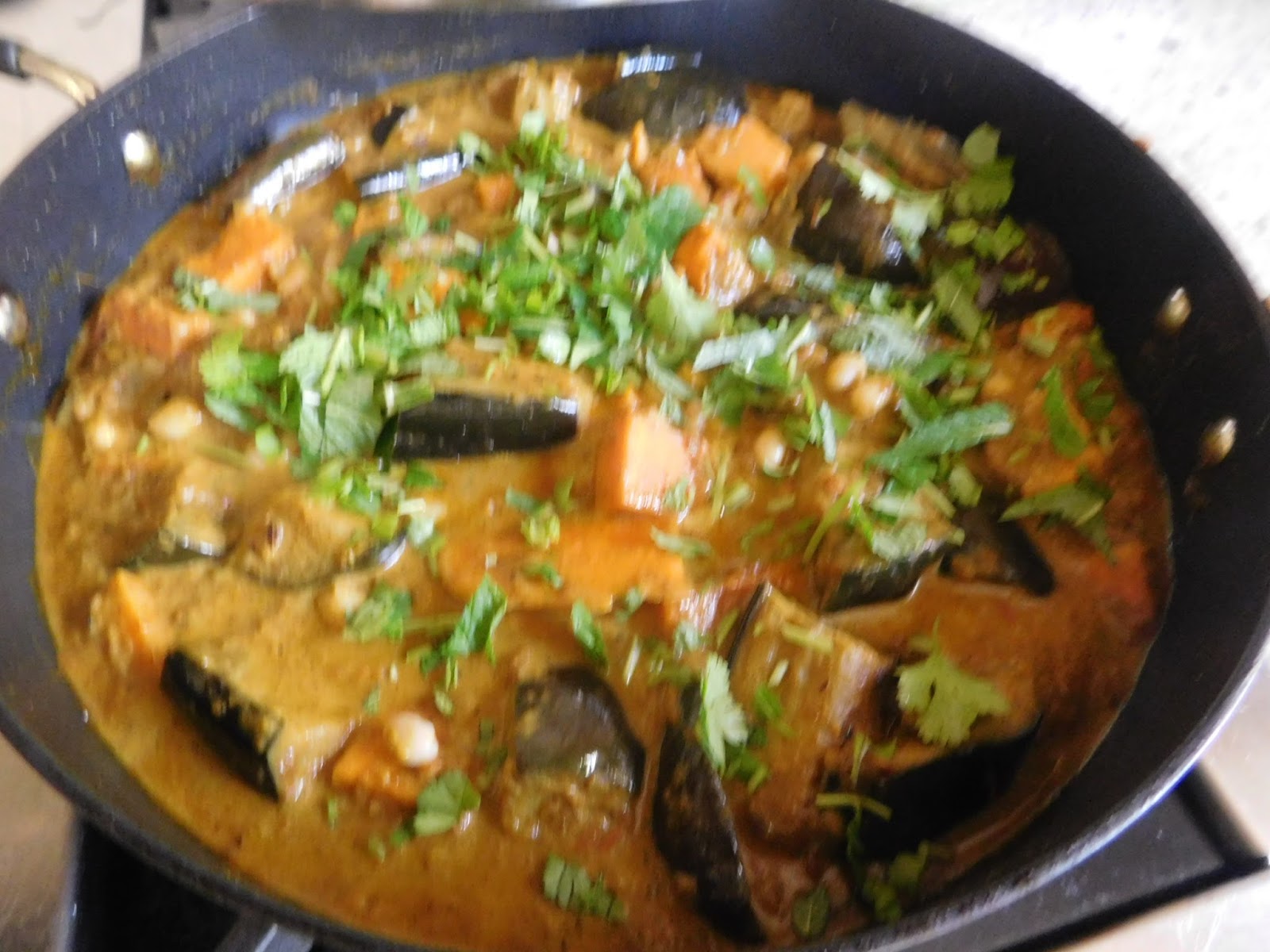
Indian Curry with Eggplant and Sweet Potato

Eggplant is my favorite vegetable. For vegetarians, the combination of eggplant and sweet potato is best to create a healthy and delicious dish. I love Indian curry more than any other Asian curry because it has a depth of flavor with a lot of spices other than just curry powder. Today, I will introduce one of my favorite Indian dishes. I include the tomato-onion gravy as one of the sauces that should always be kept on hand if the Indian cuisine is the choice of food. Making this sauce is very easy, and, after making that, the rest of Indian cooking will prevail.

Ingredients:
Tomato-onion gravy ingredients:
1/4 cup total consisting of equal amounts of chili powder. turmeric, cumin, and coriander
2 tbs total consisting of equal amounts of ginger and garlic paste
1 lb. tomatoes, chopped
1 lb. white onions, chopped
1/4 cup oil
Salt to taste
1 cup water
Eggplant curry ingredients:
1 large eggplant
1 sweet potato or any potato of your choice
1 tsp curry powder
1/4 tsp mustard powder
1/4 tsp fennel seeds
1 tsp ginger
1 tsp garlic
1 bay leaf
2 tbs oil
2 cups gravy
1 can of coconut milk (about 14.5 oz.)
Salt and pepper to taste
 
Garnish with chopped cilantro and mints

Directions:
To make the gravy:
In a sauté pan, add oil. Heat until hot. Stir in the mixture of chili powder, turmeric, coriander, cumin, and ginger garlic paste. Stir and cook until fragrant.

 Stir in tomatoes and onions. Make a quick stir; Cover and cook for 1 hour.


 You also can cook the gravy in a slow cooker on the low setting for 3 to 4 hours. Season with salt and pepper.

For the eggplant curry:
Wash and cut eggplant into bite-size pieces (I like to soak eggplant in a bowl of water and lemon). This method will make the eggplant less bitter. Drain.


Peel and cut the sweet potato. You can steam the sweet potato or cook it in a microwave. I have a NuWave® oven, so I bake my potato until cooked.

In a pot, add oil and sauté the curry powder, mustard, and fennel seeds until fragrant. Add ginger and garlic and continue cooking for another 3 minutes.

Add eggplant and stir. Cook eggplant until almost soft and tender.

 Add 2 cups gravy and bring to boil.

 Add cooked sweet potatoes and coconut milk.


Bring it back to boil and season with salt and pepper. Now it ready to serve with rice but do not forget the cilantro and mints.


Friday, April 15, 2016

Sweet Rice with Yuca Roots (Xôi Khoai Mì)


Most of us have a dish from childhood that follow us throughout our lives. With me,
sweet rice with yucca roots (Xôi Khoai Mì) topped with scallion oil and add a little soy sauce and chili pepper is a dish that I have loved since childhood. However, my mother did not like yucca roots, because she believes that the poison in cassava is not good for health, and consuming a lot of yucca will make us feel dizzy like people feel seasick on the boat. Apparently, according to the web site, Living Strong http://www.livestrong.com/article/158692-yucca-root-health-benefits, yucca is a very healthy root. Even though I enjoy this dish, my mom only made it  when I was very good. For that reason,  Xôi Khoai Mì also became it brings back memories about my mom. Sweet yucca rice dish is actually a very rustic dish and inexpensive to implement. Normally, I do not usually make this dish because I have  go to a Korean or Vietnamese market  to buy yucca. However, yesterday, when I had gone to the newly opened organic supper market – voila! I was surprised then when I saw that yucca was sold there and memories came flooding back,  I  bought 1 lb. of yucca  immediately. However, I still remember mom's advice when making Xôi Khoai Mì that the yucca needs to soak overnight with water so the poison is eliminated before cooking. When I got home, immediately I peeled the yucca skin and soaked it in water so I would be able to prepare the childhoods cassava dish for breakfast today. Hope this recipe will always be a breakfast dish reminiscent of my homeland.

Ingredients:
1 ½ pounds of yucca (about 2 yucca roots)
2 cups sweet rice
1/2 tsp salt
1 tsp mushroom seasoning
Scallions oil ingredients:
3 green onions, sliced
1/8 tsp salt
1/8 tsp sugar
1/4 cup olive oil

Directions:
Peel and cut yucca into 1/2 inch pieces. Be careful to remove the core; otherwise, it is hard to chew. Soak in water overnight.


Wash the sweet rice a few times until the water is clear and also soak in water overnight.


The next morning place a steamer on the stove over high heat. This step is important to steam the rice.
Drain the yucca and the rice. Add both of them in a bowl or still use the sieve. Add salt and mushroom seasoning. Mix well.


 When the steamer is boiling, add the rice-yucca mixture on to the steamer; Cover and cook for 30 minutes.

 In the last 10 minutes pour 1/4 cup of the hot water over the rice (this method assures that the rice is soft, not dry).
While the rice is cooking, add the scallions in a microwave heatproof bowl. Add salt, sugar, and oil. Place in microwave and cook for 30 or 40 seconds.


To serve:
Scoop the rice-yucca on a serving plate. Top with scallion oil and place some soy sauce on the side.

Italian Garlic Chicken

During spring or summer, my herbs garden is fantastic. I have oregano, thyme, tarragon, and parsley. These herbs are used all the time in Italian cooking and other countries cuisines, such as France, England, etc. One easy recipe is chicken cooked with garlic and tomatoes. I like this recipe because it is light and has no need to add cheese to this dish like most Italian dishes. The ingredients are simple and most cooks will have them. Even though fresh herbs might not be available, dry herbs can be used. The only thing I do differently is to remove the skin from the chicken thighs for my family’s taste and health concerns. Other than that, this recipe is easy to put together.

Ingredients:
2 lbs. of chicken thighs
Marinade ingredients:
1/2 cup chopped fresh herbs: thyme, parsley and oregano
4 garlic cloves, minced
1/4 cup olive oil
Salt and pepper
Other Ingredients:
2 to 3 fresh tomatoes, sliced
1 bay leaf
1/2 red onions, chopped
1/4 cup Chardonnay
1 cup green or black olives
 

Garnish with more chopped fresh parsley

Directions:
Remove chicken thigh skin and cut thighs into large pieces.


Combine the marinade ingredients in a large mixing bowl with lid or a Ziploc bag. Add the chicken and marinate for a few hours.

Heat a heavy sauté pan over medium high heat. I do not add any more oil for this because there is enough oil in the marinade. When the pan is hot, add the chicken and brown chicken for five minutes.


 Add the marinade, stir, and cook until fragrant.

 Add wine and cook for 3 minutes or until the wine evaporates. Add bay leaf, tomatoes, and red onions.

Stir to combine and cover with lid. Cook for 15 minutes. Uncover and season with more salt, if needed. Check the chicken to see if it is tender.

 If so, then stir in the olives. Continue to cook for another 5 minutes. Serve on a platter. Garnish with fresh chopped parsley. Accompany with bread, pasta, or even rice.